The Difference Between an AI That Chats and an AI That Acts
Most AI assistants are sophisticated text generators. An AI that takes action is a different category — it completes tasks, not conversations. Here's what separates them and why it matters.
When someone says "AI assistant," they almost always mean a chatbot. You open an app, type a question, read an answer, close the app. The AI helped you think. You still have to act.
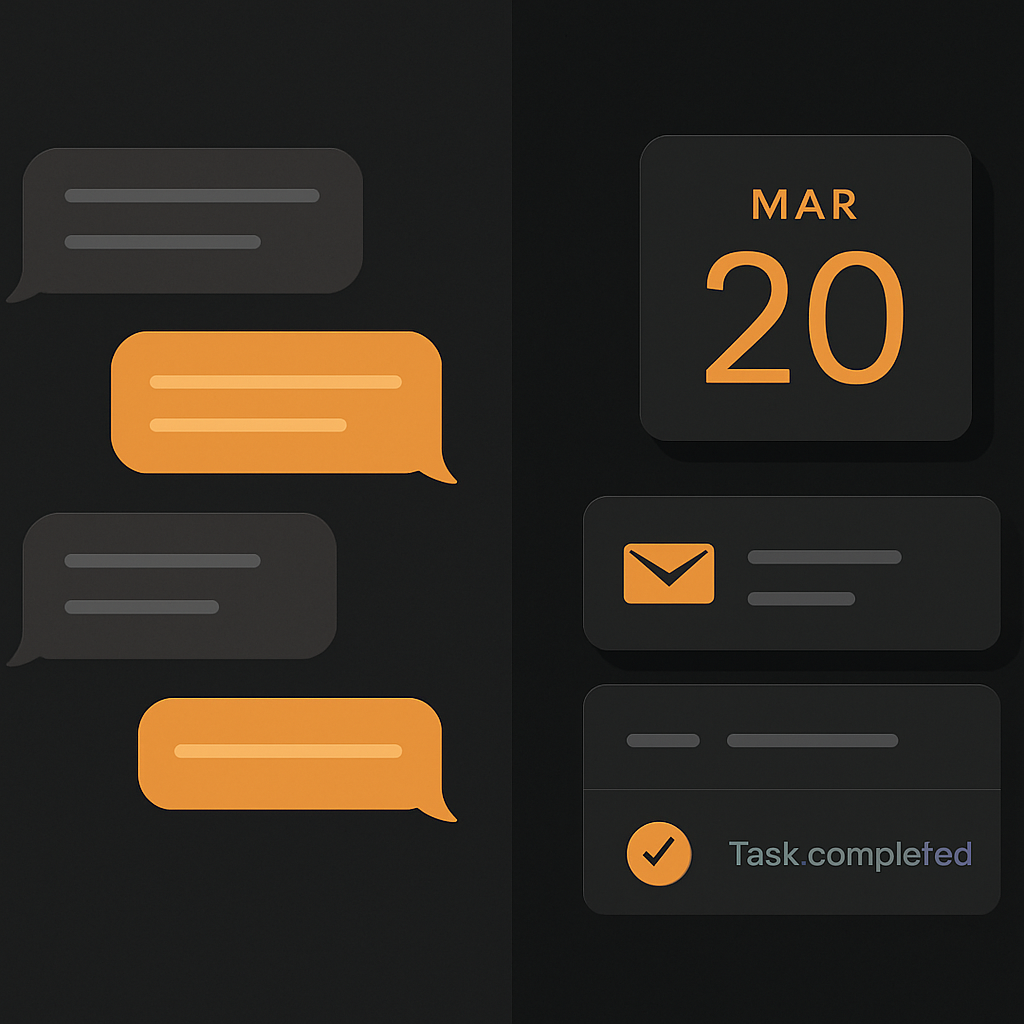
This is the distinction most people haven't named yet, but feel every day: the gap between an AI that generates text and an AI that takes action. They're not the same thing. They're not even close.
Definition
AI that takes action
An AI system that executes tasks in connected real-world systems — calendar, email, messaging, web — autonomously and on your behalf, without requiring you to manually complete each step. Distinct from conversational AI, which generates text responses within a session window.
What "AI assistant" actually means in 2026
Today, "AI assistant" describes two fundamentally different things that happen to share a name. The first is conversational AI — tools like ChatGPT, Claude, and Gemini that respond to prompts within a session. The second is action-taking AI — systems that operate autonomously in connected environments to complete real tasks.
Both are genuinely useful. But they solve different problems. A conversational AI helps you draft an email. An action-taking AI sends it.
The confusion between them has real costs. People pay $20/month for ChatGPT Plus expecting an assistant — then spend their time manually executing everything the AI recommends. That's not an assistant. That's a very expensive notepad.
An AI that acts is an AI system capable of taking real-world actions autonomously — scheduling calendar events, sending emails, following up on leads — without requiring the user to initiate each step. The distinction from conversational AI: it executes, not just responds.
The passive AI trap
Passive AI is AI that generates output and stops. You do the rest. This describes most AI tools on the market today, including the popular ones.
Here's what passive AI actually looks like in a workday:
- You ask ChatGPT to draft a follow-up email to a lead. It drafts one. You open Gmail, paste it, edit the To field, send it.
- You ask Claude to suggest times for a meeting. It suggests three. You open your calendar, create the event, send the invite.
- You ask Gemini to summarize a competitor's new features. It summarizes. You make a note somewhere to revisit this.
In every case, the AI reduced thinking time but left execution entirely to you. The bottleneck didn't move. You're still the one doing the work.
This is the passive AI trap: tools that feel like help but don't actually reduce your workload. They offload cognition, not tasks.
What action-taking AI actually does differently
Action-taking AI closes the loop. It doesn't just generate the email — it sends it. It doesn't suggest calendar times — it books them. It doesn't summarize the competitor — it monitors them weekly and surfaces what changed.
Three things make this structurally different from conversational AI:
1. Tool access
Action-taking AI has real connections to external systems — your calendar, your email, the web, your contacts. It doesn't describe what it would do; it does it. This requires infrastructure beyond the language model itself: authenticated integrations, sandboxing, error handling, and permissions.
2. Persistent operation
Conversational AI is session-bound. Close the tab, the context disappears. Action-taking AI runs continuously — it can execute a task at 2am, remind you on Thursday, or check back on an unanswered email next week without you ever prompting it again.
3. Autonomous execution
You set the goal once. The AI figures out the steps, executes them in the right order, and reports back when done or when it needs your input. You're not orchestrating every micro-decision — you're delegating an outcome.
Side-by-side: the same tasks, two different tools
The difference becomes concrete when you look at the same request handled by each type of system.
| Task | Conversational AI (ChatGPT, Claude) | Action-taking AI (Deputy) |
|---|---|---|
| Follow up with a lead | Drafts an email. You copy, paste, send. | Sends the email. Adds a reminder if no reply in 5 days. |
| Block focus time | Suggests which slots to use. You create the event. | Creates the calendar block. Done. |
| Monitor a competitor | Summarizes what you paste in. You check manually. | Checks weekly. Sends you a brief when something changes. |
| Daily briefing | Generates a template if you ask for it. | Texts you a summary every morning. You didn't ask. |
| Cost | $20/month regardless of how much you use it | Pay only when it does work. Free to start. |
| Works while you sleep | No | Yes — 24/7 |
Why this distinction isn't obvious yet
The marketing language hasn't caught up to the technology. Every AI product — whether it's a chatbot or an autonomous agent — calls itself an "AI assistant." The word has been diluted to the point of meaninglessness.
This matters because people are making purchasing decisions based on a category label that describes completely different experiences. Someone who pays $20/month for ChatGPT Plus expecting delegation is going to be disappointed — not because ChatGPT is bad, but because they bought a different tool than they thought.
The right question isn't "does this AI understand me?" — most modern AI systems understand you well enough. The right question is: does this AI do the work, or does it describe the work?
Who actually needs an action-taking assistant
Not everyone does. Conversational AI is the right tool for certain jobs — brainstorming, drafting, research synthesis, code review. If you're doing creative or analytical work that requires your judgment at every step, a chatbot is appropriate.
Action-taking AI is for people whose bottleneck is execution, not thinking. Specifically:
- Small business owners and solopreneurs who are doing work that an assistant would normally handle — follow-ups, scheduling, research, reminders
- Sales and business development professionals who have leads falling through the cracks because follow-ups require attention they don't have
- Busy professionals who know what needs to happen but can't get to it fast enough
- Anyone paying for multiple AI subscriptions and still manually orchestrating every output
If you've ever thought "I wish I could just tell someone to handle this" — that's the gap action-taking AI fills. Not more text to read. Someone to actually handle it.
Deputy is an AI personal assistant that actually does things.
Lives in your text messages. Manages your calendar, drafts and sends emails, follows up on leads, does research — 24/7. Free to start, pay only when it works for you.
Get Started Free →The infrastructure requirement
Building action-taking AI requires infrastructure that most conversational AI products don't have. Tool integrations, persistent execution environments, authenticated connections to external services, billing systems that can track actual usage rather than flat subscriptions.
This is why there are thousands of chatbots and very few true action-taking assistants. The language model problem is mostly solved. The infrastructure problem — making AI that operates reliably in the real world, at scale, for real users — is harder.
Deputy is built on ATXP (Agent Transaction Protocol) — infrastructure that provides 14+ tools, identity, payments, and always-on execution for AI agents. It's what makes true action-taking possible without asking users to manage their own API keys or server infrastructure.
What to ask before choosing an AI tool
Given how muddled the "AI assistant" category has become, here are the questions that cut through:
| Question | If yes → | If no → |
|---|---|---|
| Does it work when you're not using it? | Action-taking AI | Conversational AI |
| Can it send emails or book calendar events? | Action-taking AI | Conversational AI |
| Does it cost money when you're not using it? | Subscription model (likely chatbot) | Usage-based model (more likely agent) |
| Do you have to initiate every interaction? | Conversational AI | Action-taking AI |
"It can be everything from your smartest friend to your most trusted colleague. Right now it will stumble on a bunch of things, but it will quickly learn from them and be able to do them next time. So anything you're going to do two or more times (and you don't love doing) — you should start training it how to do now."
Louis Amira
Founder & CEO, Deputy / Circuit & Chisel
FAQ: AI that takes action vs AI that chats
What is an AI that takes action?
An AI that takes action completes tasks on your behalf — sending emails, booking calendar time, following up on leads, doing research — rather than generating text you then have to act on yourself. The defining characteristic is autonomous execution: the AI does the work, not just the thinking.
What is the difference between a chatbot and an AI personal assistant?
A chatbot responds to prompts with text. An AI personal assistant takes real-world actions in connected systems — calendar, email, web, messaging. Chatbots are input-output tools; AI personal assistants are autonomous agents that complete tasks whether or not you're actively engaged.
Does ChatGPT take action?
ChatGPT can browse the web and run code, but it cannot send emails, manage your calendar, follow up on leads, or take action in external systems on your behalf. It operates within a conversation window that closes when you do.
What can an action-taking AI assistant do that ChatGPT cannot?
An action-taking AI assistant can operate autonomously outside a conversation window — scheduling calendar events, sending emails, monitoring for replies, executing recurring tasks, and taking action while you sleep. ChatGPT is session-bound; an action-taking assistant is always on.
Is an AI personal assistant safe to use for real tasks?
Yes, with appropriate guardrails. Responsible action-taking AI systems confirm before irreversible actions, maintain audit trails, and allow users to set permission levels per capability. You decide how much autonomy the assistant has.
Related reading:
- The Hidden Costs of "$20/month" AI Assistants — Why flat subscriptions don't match how people actually use AI
- What Is an AI Personal Assistant That Actually Does Things? — A closer look at what action-taking looks like in practice
- ChatGPT Alternatives for People Who Want Results, Not Replies — Side-by-side comparison of the top options