How to Automate Follow-Up Emails with AI (Without Building Automations)
Most follow-ups never happen — not because people forget they matter, but because sending them requires time nobody has. Here's how AI can handle it automatically, starting from a single text.
You know you should follow up. The data backs you up. Your gut backs you up. You just don't do it — not consistently, not at scale, not for every conversation that deserves it.
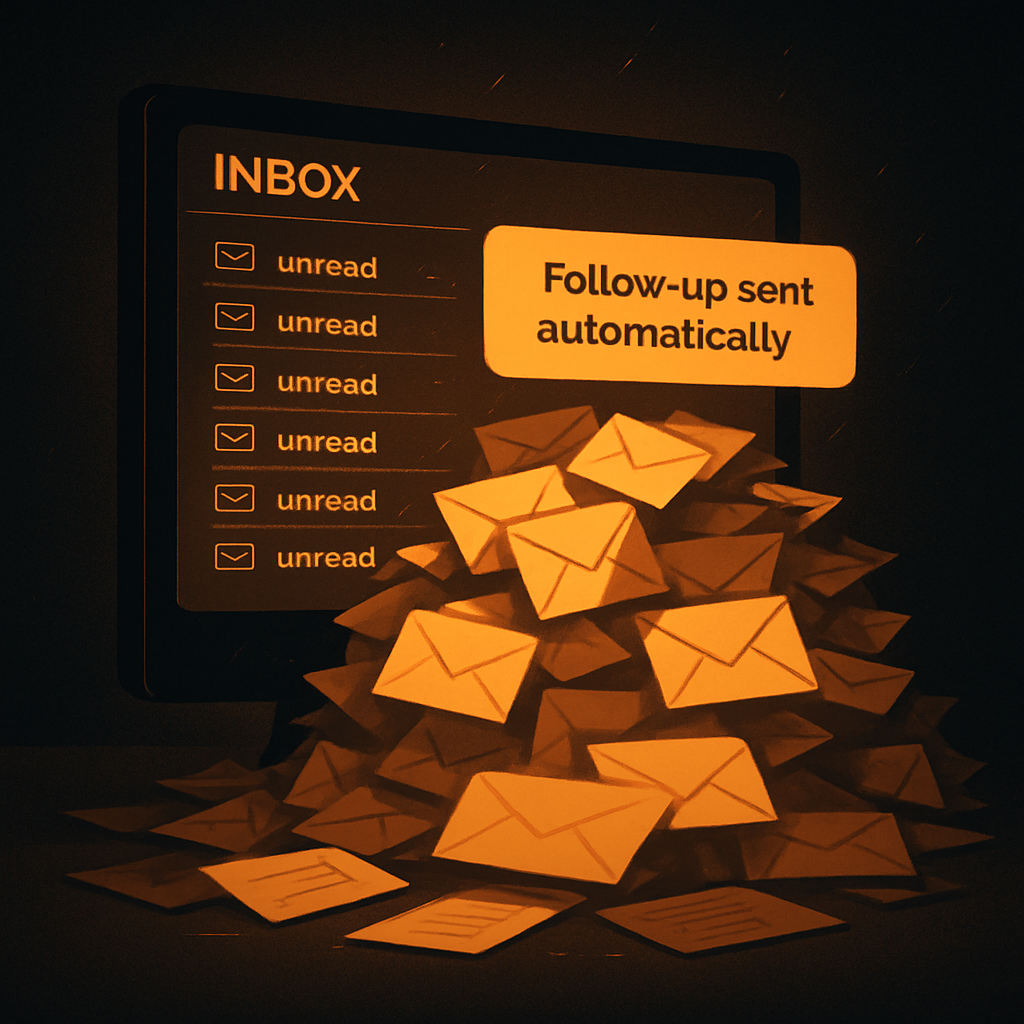
That's the problem AI can actually solve here. Not by writing better templates. By sending the email without you having to remember to send it.
Why follow-up emails don't get sent
The real reason follow-ups fall through isn't laziness — it's that sending a timely, personalized follow-up requires at least four separate decisions: when to send, what to say, where to say it, and whether it's still relevant. Multiply that by every open conversation in your pipeline and the cognitive load compounds fast.
The stats confirm the gap between intention and execution. According to Invesp, 80% of sales require 5 or more follow-ups to close — but 44% of salespeople give up after just one attempt. This isn't a motivation problem. It's a systems problem.
And the cost of not following up is measurable: Backlinko's 2024 analysis found that initial cold emails get an average response rate of 8.5%, but follow-up emails in the same thread earn an 18% response rate — more than double. The follow-up is often more effective than the first touch.
An automated follow-up is a message sent on a predetermined schedule or trigger — without manual intervention — to re-engage a contact who hasn't responded. AI-driven follow-ups go further: they personalize content, adapt timing based on prior interactions, and operate across email and SMS without a workflow builder.
The two ways to automate follow-up emails
There are fundamentally two approaches to automating follow-ups, and they work for different situations.
| Approach | How it works | Setup required | Best for |
|---|---|---|---|
| Workflow automation | Trigger-based sequences (e.g. Lemlist, Outreach, HubSpot) | High — build sequences, define delays, write all steps | Cold outreach at volume |
| AI assistant | Conversational — tell it once, it handles sending and timing | None — one text message to instruct | Individual and relationship-based follow-ups |
Workflow automation tools are powerful for repeatable sequences — cold outreach cadences, post-demo drips, re-engagement campaigns. They require real setup time but pay off at scale.
AI assistants like Deputy are better for the follow-ups that don't fit a sequence: the warm lead you met at an event, the proposal you sent last week, the intro call you had on Tuesday. These are context-dependent and happen constantly — exactly where workflow tools fall short.
Definition
AI follow-up automation
Using an AI assistant to autonomously send follow-up emails based on natural-language instructions — without building sequences, configuring triggers, or manually drafting each message. The AI handles timing, personalization, and delivery based on context you provide conversationally.
How to automate follow-up emails with an AI assistant (the Deputy way)
With Deputy, automating a follow-up takes one text message. No dashboard, no sequence builder, no CRM integration required. Here's exactly how it works.
Step 1: Text Deputy the instruction
Open a conversation with your Deputy number and send something like: "Follow up with Marcus at Apex Consulting tomorrow morning — we talked about the Q2 contract and he wanted to think it over." That's the entire input. Deputy has what it needs.
Step 2: Deputy drafts and schedules the email
Deputy pulls Marcus's email from your contacts, drafts a follow-up using the context you gave it, and schedules it for the next morning. It may confirm the draft with you via text before sending — you can reply with edits or just "send it."
Step 3: Deputy monitors for a reply
If Marcus doesn't reply within a timeframe you set, Deputy can send a second follow-up automatically. If he does reply, Deputy notifies you via text with a summary of his response and suggested next actions.
Step 4: Close the loop
You reply to Deputy's text — "book a 30-minute call with him next week" — and it handles the scheduling without you opening a calendar or email client. This is what separates it from AI that chats vs. AI that acts.
Deputy follows up automatically — text it once, it handles the rest
No automations to build. No CRM to configure. Just text Deputy like you'd text a human assistant.
Try Deputy FreePay only when Deputy does work for you.
What happens when Deputy follows up for you
When Deputy sends a follow-up on your behalf, it doesn't feel generic — because it isn't. The email uses the context from your original instruction: the person's name, the topic you discussed, any relevant timing details. The result reads like something you wrote, because the intelligence behind it came from you.
Here's a comparison between what a manual follow-up process looks like versus letting Deputy handle it:
| Step | Manual process | With Deputy |
|---|---|---|
| Remember to follow up | You — calendar reminder, sticky note, CRM task | Deputy — scheduled from your original instruction |
| Draft the email | You — open Gmail, think, write | Deputy — drafted from context, confirmed via text |
| Send it | You — manually | Deputy — automatically at the right time |
| Track replies | You — check inbox periodically | Deputy — notifies you via text with summary |
| Send second follow-up | 44% of reps never do (Invesp) | Deputy — automatic if no reply received |
When to use workflow automation instead (being honest)
AI assistants aren't the right tool for every follow-up scenario. Workflow automation wins when you need scale, repeatability, and detailed analytics. If you're running a cold outreach campaign to 500 prospects with a defined multi-step cadence, tools like Lemlist, Apollo, or HubSpot sequences are purpose-built for that.
Deputy is better suited for the follow-ups that require context and judgment — the kind that a sequence builder can't anticipate. Relationship-based sales, client check-ins, warm inbound leads, post-meeting next steps. These are the gaps that fall through in most businesses because they're too personal to automate with triggers, but too numerous to handle manually.
The honest answer: most growing businesses need both. Sequences for outbound volume. An AI assistant for everything else. For more on how Deputy fits into your broader workflow, see Deputy for small business and our breakdown of the best AI personal assistants on the market.
"We care a lot more about the last mile and 'making things actually work' than the glitzy demos."
Louis Amira
Founder & CEO, Deputy / Circuit & Chisel
FAQ
Can AI actually send follow-up emails on my behalf?
Yes — with the right AI assistant. Tools like Deputy connect to your email and send follow-ups autonomously after a simple text instruction. Most AI chatbots can draft follow-ups but require you to paste and send them manually. Deputy handles the full loop: drafting, sending, and monitoring for replies.
What's the difference between AI follow-up and tools like Lemlist or Outreach?
Email automation platforms require you to build sequences upfront: define triggers, write every step, set delays. AI follow-up via Deputy works conversationally — you text it once and it handles the timing and sending. No sequence builder, no CRM integration required. Better for ad hoc follow-ups on individual conversations, not bulk cold outreach.
How many follow-ups should I send before giving up?
Research from Invesp shows 80% of sales require 5 or more follow-ups — but 44% of reps stop after just one. The data suggests persistence matters more than most people act on. With AI handling follow-ups automatically, you don't have to choose between persistence and bandwidth.
Will AI follow-up emails sound robotic?
Only if you don't give it context. When you tell Deputy "follow up with Sarah about the proposal we discussed Tuesday," it uses that context to write a natural, specific email — not a generic template. The quality is tied directly to the context you provide.
Louis Amira
CEO, Circuit & Chisel
Louis builds AI infrastructure for autonomous agents. Deputy is Circuit & Chisel's personal AI assistant product, built on the ATXP agent platform.